From Scan to SolidWorks: Reverse Engineering the Porsche 911 GT3 for Design Modification

When it comes to modifying the iconic design of a high-performance vehicle like the Porsche 911 GT3, precision and flexibility are paramount. This project showcases a powerful workflow for capturing the complex, freeform surfaces of a car's exterior and converting them into a fully editable, parametric CAD model ready for design modifications.
The Challenge: The primary goal was to create a "design intent model"—not just a copy of the surface, but a feature-based CAD model that could be easily manipulated in SolidWorks. This required a seamless bridge between the physical car and the digital design environment.
The Process:
3D Scanning: The process began by capturing the precise geometry of the Porsche 911 GT3's body using an Arm Scanner. This provided the high-quality scan data needed to replicate its signature curves.
Full Feature Modeling in Geomagic Design X: The scan data was then processed in Geomagic Design X. This powerful reverse engineering software was used to perform full feature modeling, transforming the point cloud data into an accurate and intelligent 3D model. This intensive step took 27 hours to complete.
LiveTransfer to SolidWorks: The crucial step was bridging the gap to a parametric CAD environment. Using the Solidworks LiveTransfer feature in Geomagic Design X, the model was transferred directly into SolidWorks. This unique function automatically rebuilds the model with a complete feature tree, including sketches, extrusions, and surfaces. This transfer process, which took 7.5 hours, resulted in a native SolidWorks model that is fully editable, not a static, imported surface.
The Result:
The entire workflow, from scanning to a fully parametric SolidWorks model The final output is a design-ready CAD file that allows engineers and designers to easily modify and build upon the original aesthetics of the Porsche 911 GT3, confident that their model is based on precise, real-world data. This case study perfectly illustrates how modern reverse engineering tools can accelerate automotive design and customization projects.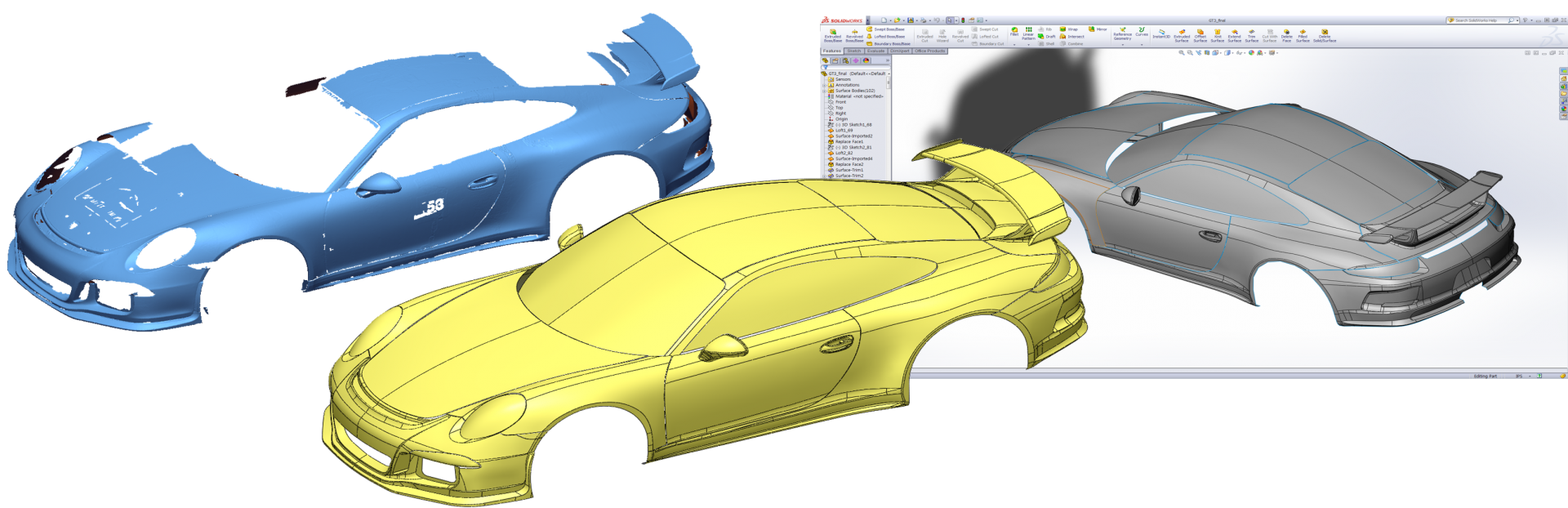
Comments
Post a Comment